
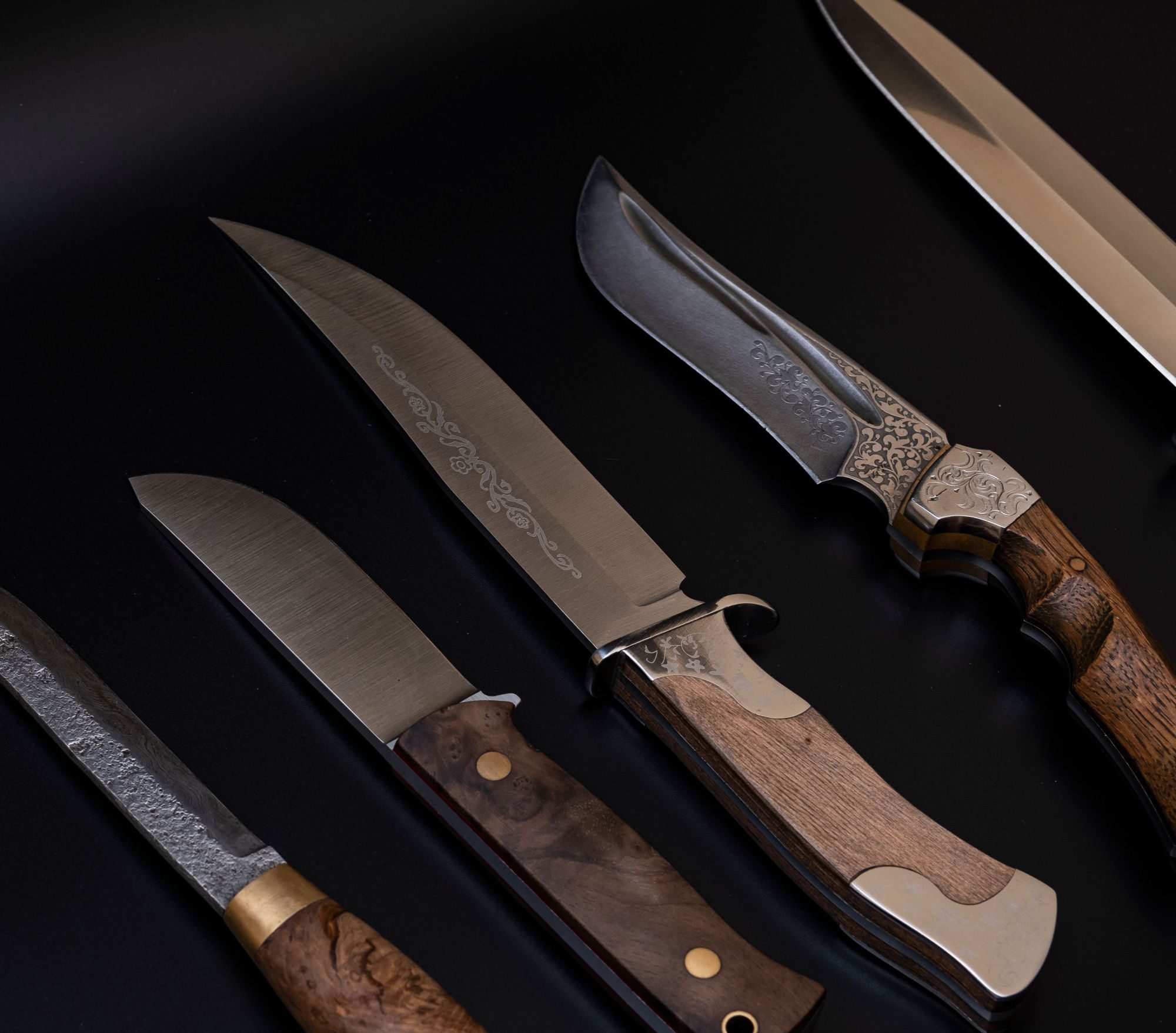
It’s something we use several times a day, without which no civilisation would be able to develop and central to several professions. Let’s talk about the humble knife. Whether it be a table knife for tucking into our dinner, a butcher’s or chef’s knife for preparing our food, or a pocketknife, reminiscent of those essential for our hunter gatherer forebears, we could not live without them. Here at Craft Insurance, we are proud to support clients who are traditional knife makers, keeping skills alive which have been honed and passed down through generations.
While many of us may quote Sheffield as being the centre of UK cutlery manufacturing since the Industrial Revolution, there is evidence that steel production in the area dated as far back to the the 14th century, with a reference being made to knife production by Chaucer in the 15th century. Skilled craftsmen, known as ‘little mesters’ worked within their own homes to produce knives made of steel, collecting materials from the surrounding countryside which contained not only wood from the forests, but iron ore as well. With the surrounding hills of the Peak District being the source of a number of fast flowing rivers, their natural energy was harnessed to drive heavy stone wheels which could be used for the sharpening of bladed tools such as scythes and knives. Thus, Sheffield’s geographical location and natural resources nurtured its initial, unpretentious beginnings of a trade which was to make it the “steel city” of the U.K., with exports that would be off around the globe.
It was two discoveries that happened in succession, the first by Benjamin Hunstman in 1742 and the second by Henry Bessemer in 1856, which really put Sheffield on the map as a global producer of steel cutlery. By the mid nineteenth century, steel was being produced in mass by heating coke, iron ore and scrap metal at high temperatures, producing liquid steel which could be poured into moulds, all at a cost which was financially viable. Thus, Sheffield grew into a major industrial city and global exporter of steel for items such as railway lines, armour plating for ships, construction and, of course, cutlery.
The early twentieth century saw advancements in the manufacture of stainless steel, with a surge in cutlery makers alongside this; the area in which many of these were situated, Portland Works, still houses cutlery makers today. The second half of the twentieth century, however, saw a tragic decline in Sheffield’s industrial fortunes, with the closure of many furnaces and associated loss of jobs.
Despite this decline of large-scale manufacture, it continued to be a centre for cutlery innovation and production and over the past couple of decades has seen a revival in specialist, high end knife production. Today it is home to many workshops, housing master craftsmen making artisan and bespoke knives, keeping aflame centuries old traditions. Some of these are located in the very same Portland Works as their forebears.
With a heritage like this, it is unsurprising that knife artisans are passionate about preserving traditional skills and techniques, as well as about using locally sourced and produced materials in their products. And of course it is not only in Sheffield that they may be found. Skilled bladesmiths have set up workshops across the country, producing knives made using a variety of techniques and traditions.
Hand crafted knives are obviously going to be more expensive than their mass-produced counterparts, so are they worth the extra cost? And, over the long term, how do the costs compare?
When you invest in a handcrafted knife, you are not only purchasing an implement that has longevity and character, but you are also keeping alive long held traditions and artistry. An individually crafted knife will have a life span of around thirty years and can be sharpened and mended as needed. This compares very favourably with mass produced knives which have a shorter lifespan and if they break, often discarded. Knife smiths will use locally sourced materials and techniques which are sustainable, having been used for centuries. So, you know you are investing in an item with excellent eco credentials. In addition, when you consider the cost of one of these knives with the cost of buying and replacing several mass-produced ones over thirty years, the initial expense seems much more reasonable. So, we have a single purchase which will last several decades, which is not only environmentally sustainable, but keeps alive centuries old skills, so pours money back into the local economy and brings with it a slice of history; what is there to say no to? Maybe you might start thinking of Christmas gifts? Or is there a special birthday coming up? Or maybe you could treat yourself…
A final word to any blade smiths reading this who are not yet a part of our Craft Insurance family. We too are a family run business with several decades of experience in craft insurance cover. Like your products, our craft insurance cover is unlikely to come up cheapest in a search, but this is intentional as we aspire to sell cover that does what it says it will. Our basic package of craft insurance cover comprises product and public liability insurance, as well as professional liability insurance. As a family-owned business we communicate directly with all our amazing clients, either by phone or email, whichever suits you best. So, if you’re looking to update your cover, or considering what cover to take out for the first time, why not check out our website, send us a message or give us a call. Sam or Naomi will be here to answer your questions look forward to hearing about your unique and history filled business!